St. Jerome, after his encounter with the desert in the years 375-379, wrote the “Life of St. Paul the First Hermit”. He wanted to polemicize, as it were, with the “Life of St. Anthony”, written by St. Athanasius, presenting St. Paul as the first predecessor of the aforementioned St. Anthony, because he lived and died in complete solitude. It was thanks to this biography that the person of the St. Hermit of Thebes was presented first and even more outstanding than St. Anthony. St. Jerome himself, while in the desert, came into contact with various hermits.
They told him about St. Paul, the famous Hermit of Thebes, who was discovered by St. Anthony himself before his death. St. Jerome, who had personally experienced the harshness of the desert, presented this Pauline lifestyle in his biography as the perfect model of a hermit, completely united with God. By passing on information about St. Paul of Thebes taken from two written biographies, written by St. Anthony’s disciples in Greek, and oral traditions about the famous Hermit, he contributed to the popularization of his lifestyle in the Church. St. Jerome wrote a life of St. Paul the First Hermit in Latin.
Let us now take a closer look at the life of our Hero. Paul was born in Lower Thebes into a very wealthy family. Much care was devoted to his upbringing. He became thoroughly familiar with Egyptian and Greek literature. At the age of sixteen he lost his parents and, together with his older, married sister, became the heir to a large fortune. When the persecution of Christians broke out under the Emperor Decius, being a Christian and not wanting to become a victim of the persecutors, he hid in his remote country estate. However, when he heard of the wicked plan of his brother-in-law to report him to the persecutors in order to seize his property, Paul decided to flee into the desert. However, God changed the heart of the fugitive and caused him to willingly and lovingly adopt the lifestyle to which fear and necessity had forced him.
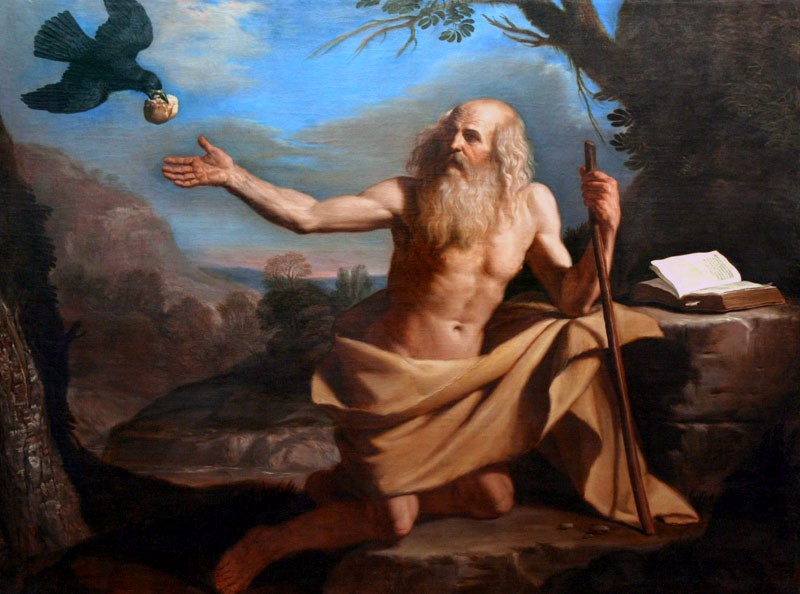
Let us see how this extraordinary “conversion” came about. Fleeing the wrath of his persecutors and the ingratitude of his brother-in-law, immersed in the endless desert in search of a safe place, Paul stood before a certain cave adjoining a stony mountain. Having removed the boulder that blocked the entrance, he saw a large “vestibule” in which a green palm tree offered its fruit and a clear spring provided drink. In addition, many caves carved in the rock – in which one could still see the remains of the tools with which the ancient forgers had minted coins – provided a safe hiding place. In this lonely, forgotten place Paul decided to live his whole life, because in everything that had happened to him up to that point he saw the work of God’s will and a call to remain, remaining in perfect silence, filled with union with God. The encouragement to this kind of calling was for him the miraculous appearance of a raven, which every day brought the Theban a portion of bread. Apart from the mention of the miraculous food, we know nothing else about the long ascetic life of the “first” hermit.
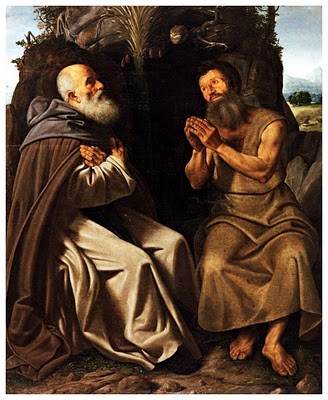
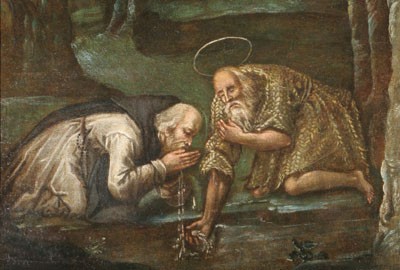
Having described the beginning of Paul’s ascetic life in the first six chapters, Jerome presents its end in the next twelve. Paul was 113 years old and Anthony 90, when the latter began to think that he was the first and most perfect Christian monk in the world. However, God, to dissuade him from this belief, let him know in a dream that there was someone living somewhere in the desert – someone who had been practicing this way of life for a long time and better than he had. He should go to convince himself of this. At sunrise, ninety-year-old Anthony took a pilgrim’s staff and set off on a journey, not knowing the way at all. After a few days, Anthony arrived at the place where the Holy Hermit Paul was staying. The guest wanted to enter. However, the old man did not want to allow this for long hours, wishing to continue living alone with God. Finally, however, he gave in and the delighted Anthony was allowed to enter. The whole evening was spent in holy conversation. The raven brought not one portion of bread for supper – as he had been accustomed to doing up to that point – but two. The night was sanctified by prayer. At daybreak the conversation of the two holy elders was resumed. Paul announced that he had known for some time that God had wanted to give him in the person of Anthony a companion in the service of God, and that he was now sending him in a miraculous way to bury his body, wrapping it in the cloak that the holy bishop Athanasius had given to Anthony.
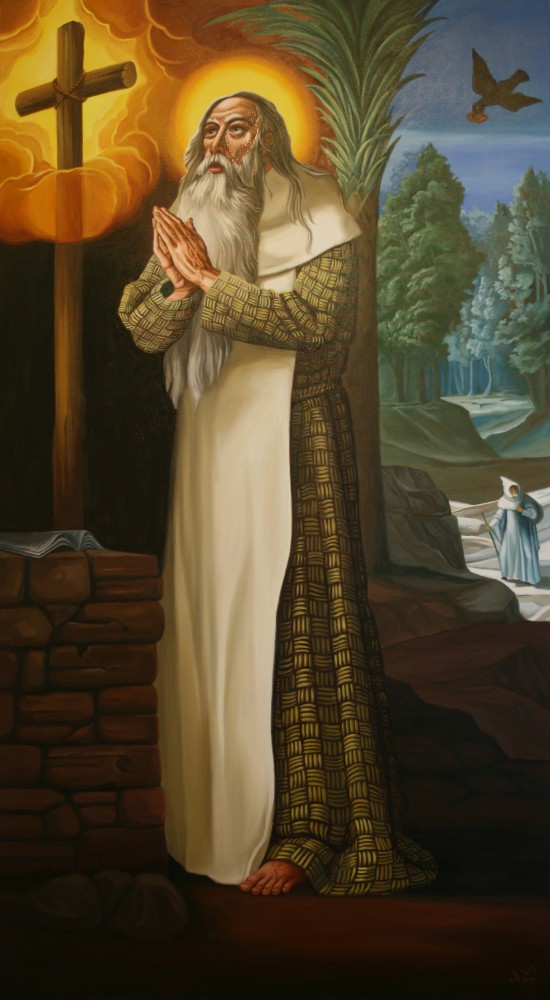
The guest, full of admiration and deeply distressed, returned with great haste to his monastery, which was three days’ journey away, to take the cloak that Athanasius had given him. On the way back, before reaching Paul’s cell, he saw the soul of the Theban ascending to heaven. This sight so excited Anthony that his march, as Jerome says, turned into a flight. However, he did not find Paul alive. He saw him kneeling, with his head raised and his hands raised to heaven. At first he thought that he was still alive and was immersed in prayer. Unfortunately, there was nothing left for him to do but to wrap the dead body of Paul in Athanasius’ cloak and place it in a tomb dug especially for this purpose by two lions, who together with Anthony were weeping over the founder and prince of the hermit’s and monastic life. Anthony took the Pauline tunic, made by the Theban from palm leaves, and returning to the monastery, he related to his disciples all that he had experienced. On the solemn days of Easter and Pentecost, he always put on the Pauline tunic.
Here is a brief account of the life of St. Paul the First Egyptian Hermit presented by St. Jerome. Hermits living in the Danube forests and wilderness in the 13th century wanted to imitate this famous Egyptian Hermit – St. Paul of Thebes and named themselves Paulines after him, creating a new religious community in the Church.
Józef Stanisław Płatek OSPPE,
art. ze str. www.jasnagora.com
Life of St. Paul the First Hermit