PERSONS

The Blessed Virgin Mary - Patroness of the Order

Whatever the Pauline does, they want to anchor everything in the attitude of Mary. In the life of our order from the beginning of its existence, Mary has played a unique role. The order has always honored her as Mother, Lady and Queen and has zealously spread this devotion. Showing Mary in the mystery of Christ and the Church, imitating her life and promoting her honor is a special mark of Pauline spirituality (cf. Constitutions of the Order, art. 4). Marianity is the hallmark of the Pauline monks. From the novitiate, growing under the eye of Our Lady of Leśniów, we try to teach Mary and her attitudes, especially deep faith, love and service.

“In the service of our Order from the beginning of its existence, Mary has played an exceptional role. She was present in the life and activity of the Pauline Order. Our Order has always honored her as Mother, Lady and Queen and has zealously spread this devotion. We are convinced that during the storms of history, of which there was no shortage in the history of the Order, her protection was a stronghold of holiness and effectiveness of the mission among the nations to which Divine Providence sent us. Hence, with full trust, we bind ourselves inseparably with Mary for the future through filial love, the desire to imitate her fidelity to God and we commit ourselves to be everywhere heralds of her greatness, participation in Christ’s salvation and her bond with the Holy Spirit” (Constitutions of the Order, art. 60)

st. Paul the First Hermit - Patriarch of the Order

St. Jerome, after his encounter with the desert in the years 375-379, wrote the “Life of St. Paul the First Hermit”. He wanted to polemicize, as it were, with the “Life of St. Anthony”, written by St. Athanasius, presenting St. Paul as the first predecessor of the aforementioned St. Anthony, because he lived and died in complete solitude. It was thanks to this biography that the person of the St. Hermit of Thebes was presented first and even more outstanding than St. Anthony. St. Jerome himself, while in the desert, came into contact with various hermits.

They told him about St. Paul, the famous Hermit of Thebes, who was discovered by St. Anthony himself before his death. St. Jerome, who had personally experienced the harshness of the desert, presented this Pauline lifestyle in his biography as the perfect model of a hermit, completely united with God. By passing on information about St. Paul of Thebes taken from two written biographies, written by St. Anthony’s disciples in Greek, and oral traditions about the famous Hermit, he contributed to the popularization of his lifestyle in the Church. St. Jerome wrote a life of St. Paul the First Hermit in Latin.

Let us now take a closer look at the life of our Hero. Paul was born in Lower Thebes into a very wealthy family. Much care was devoted to his upbringing. He became thoroughly familiar with Egyptian and Greek literature. At the age of sixteen he lost his parents and, together with his older, married sister, became the heir to a large fortune. When the persecution of Christians broke out under the Emperor Decius, being a Christian and not wanting to become a victim of the persecutors, he hid in his remote country estate. However, when he heard of the wicked plan of his brother-in-law to report him to the persecutors in order to seize his property, Paul decided to flee into the desert. However, God changed the heart of the fugitive and caused him to willingly and lovingly adopt the lifestyle to which fear and necessity had forced him.

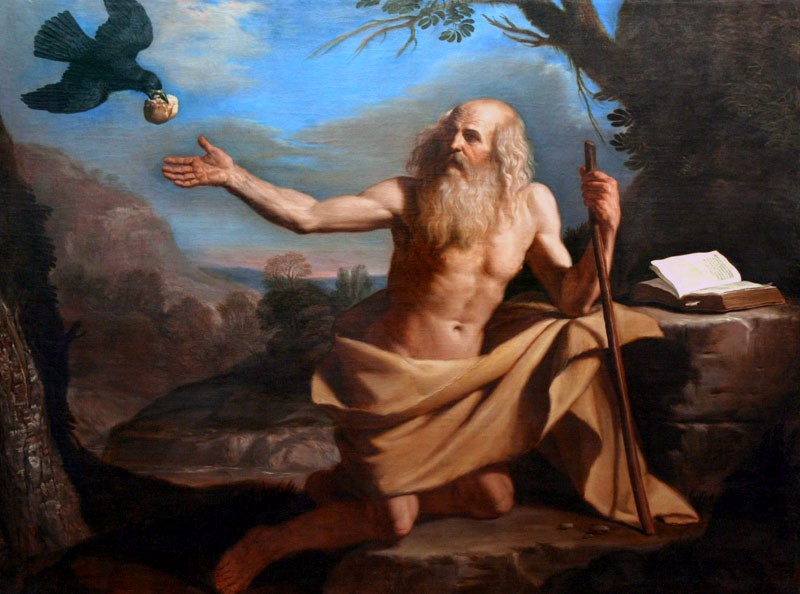
Let us see how this extraordinary “conversion” came about. Fleeing the wrath of his persecutors and the ingratitude of his brother-in-law, immersed in the endless desert in search of a safe place, Paul stood before a certain cave adjoining a stony mountain. Having removed the boulder that blocked the entrance, he saw a large “vestibule” in which a green palm tree offered its fruit and a clear spring provided drink. In addition, many caves carved in the rock – in which one could still see the remains of the tools with which the ancient forgers had minted coins – provided a safe hiding place. In this lonely, forgotten place Paul decided to live his whole life, because in everything that had happened to him up to that point he saw the work of God’s will and a call to remain, remaining in perfect silence, filled with union with God. The encouragement to this kind of calling was for him the miraculous appearance of a raven, which every day brought the Theban a portion of bread. Apart from the mention of the miraculous food, we know nothing else about the long ascetic life of the “first” hermit.

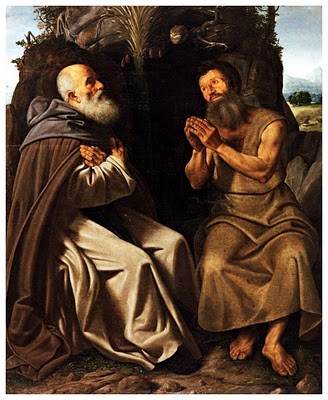
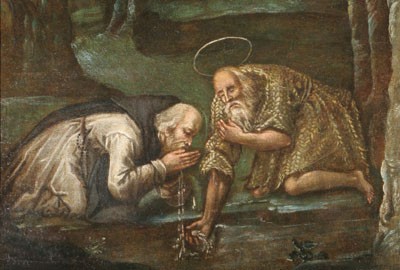
Having described the beginning of Paul’s ascetic life in the first six chapters, Jerome presents its end in the next twelve. Paul was 113 years old and Anthony 90, when the latter began to think that he was the first and most perfect Christian monk in the world. However, God, to dissuade him from this belief, let him know in a dream that there was someone living somewhere in the desert – someone who had been practicing this way of life for a long time and better than he had. He should go to convince himself of this. At sunrise, ninety-year-old Anthony took a pilgrim’s staff and set off on a journey, not knowing the way at all. After a few days, Anthony arrived at the place where the Holy Hermit Paul was staying. The guest wanted to enter. However, the old man did not want to allow this for long hours, wishing to continue living alone with God. Finally, however, he gave in and the delighted Anthony was allowed to enter. The whole evening was spent in holy conversation. The raven brought not one portion of bread for supper – as he had been accustomed to doing up to that point – but two. The night was sanctified by prayer. At daybreak the conversation of the two holy elders was resumed. Paul announced that he had known for some time that God had wanted to give him in the person of Anthony a companion in the service of God, and that he was now sending him in a miraculous way to bury his body, wrapping it in the cloak that the holy bishop Athanasius had given to Anthony.

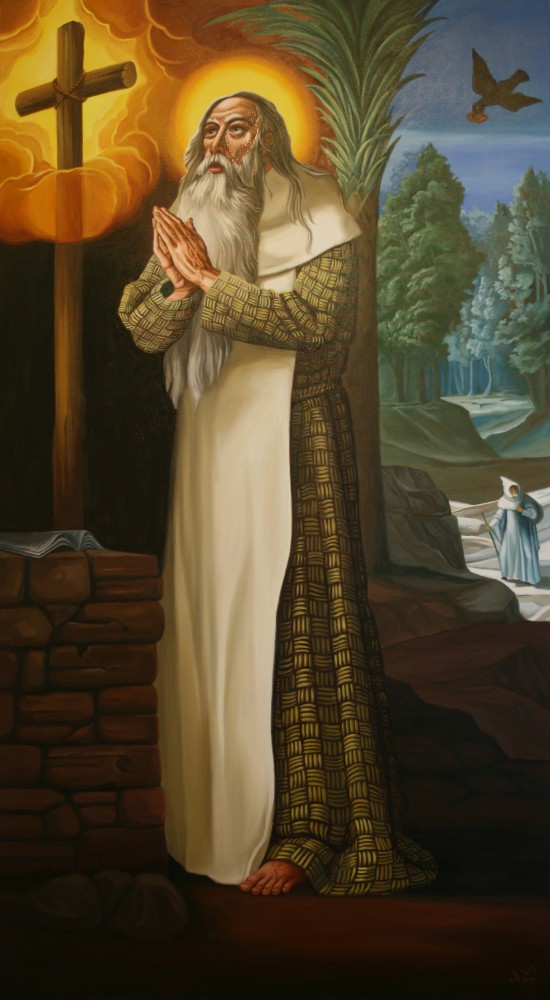
The guest, full of admiration and deeply distressed, returned with great haste to his monastery, which was three days’ journey away, to take the cloak that Athanasius had given him. On the way back, before reaching Paul’s cell, he saw the soul of the Theban ascending to heaven. This sight so excited Anthony that his march, as Jerome says, turned into a flight. However, he did not find Paul alive. He saw him kneeling, with his head raised and his hands raised to heaven. At first he thought that he was still alive and was immersed in prayer. Unfortunately, there was nothing left for him to do but to wrap the dead body of Paul in Athanasius’ cloak and place it in a tomb dug especially for this purpose by two lions, who together with Anthony were weeping over the founder and prince of the hermit’s and monastic life. Anthony took the Pauline tunic, made by the Theban from palm leaves, and returning to the monastery, he related to his disciples all that he had experienced. On the solemn days of Easter and Pentecost, he always put on the Pauline tunic.

Here is a brief account of the life of St. Paul the First Egyptian Hermit presented by St. Jerome. Hermits living in the Danube forests and wilderness in the 13th century wanted to imitate this famous Egyptian Hermit – St. Paul of Thebes and named themselves Paulines after him, creating a new religious community in the Church.

Józef Stanisław Płatek OSPPE,
art. ze str. www.jasnagora.com

Life of St. Paul the First Hermit

Blessed Eusebius - Organizer of the Order

Blessed Eusebius was born in Esztergom, Hungary, of noble and Christian parents. From the cradle he gave no small evidence of future uprightness of morals. He considered it inappropriate to begin his youth with games, jokes and feasting, remembering the words of the prophet Jeremiah: “It is good for a man to bear the yoke in his youth” (Lam 3:27). However, whether from innate goodness or because of a strong nature, he preserved the lily of innocence of unblemished whiteness amid the thorns of this world. He remained so and continued to be so with the passing of age, when he was already numbered among the canons of the metropolitan church of Esztergom. In this position, he was all the more zealous in the practice of mortification, in economy of words, in humility and in the exercise of mercy, the more he showed himself to be far from secular life and honest in the pious practices proper to the clerical state. Apart from constantly devoting himself to prayer and meditation, he tried to obtain the grace of God through the daily Sacrifice of the Holy Mass, for whose glory and pleasure he gave himself entirely and all matters. Towards the poor of Christ he constantly showed such generosity that he seemed to have a community of property with them. He was convinced that greater is the happiness of what he gives than of what he receives. This was the reason why hermits often came to Eusebius from the wilderness. He received them kindly in his house and spoke to them very graciously. Eusebius’ heart could not be moved or attracted by what he heard. Entirely fired up by the desire for this kind of life, after many contemplations in a concentrated spirit, he intended to submit himself to the yoke of Christ. Therefore, when the Tartar storm had passed, he reawakened his old desire. The Archbishop (of Esztergom) complied with the request of the man whose holiness he had already known well. So Eusebius, having distributed all his wealth to the poor, withdrew with a few companions to the solitude of Mount Pilis, near Shanto, near the triple cave once inhabited by other hermits. It so happened that when Eusebius was praying at night, flames of fire appeared, scattering through the wilderness “like sparks through stubble” (cf. Wis 3:7). Seeing this, amazed at the extraordinary nature of the phenomenon, the Blessed One wondered amidst uncertainty and hesitation what these torches, rising singly and burning by themselves, could foretell? But lo, these flames converge into one fire and with their intensified light dispel the darkness of the night and the hermitage. In the midst of the night, a day seemed to shine brighter than high noon. The more Eusebius marveled at the rarity of the fact, the more fervently he implored God to reveal and make known this mystery to him. The young Eusebius was heard by the grace of heaven.

For a voice was heard from above, that these burning torches signified hermits scattered throughout the wilderness, living apart in solitude hermitage. They will bring greater spiritual fruit in the future if they give up solitary life and gather in one monastic community. Under the influence of this voice from above, Eusebius took six of his companions with him, built a modest church on Mount Pilis under the invocation of the Holy Cross, right next to the aforementioned triple grotto. This took place around the year 1250. A small monastery was added to this church. The venerable man Eusebius, fulfilling the office of superior among his brethren, shone a saving example to all, like a “lamp placed on a lampstand”. At the same time, he was in every respect a “living model for the flock”, as the Apostle expresses it (IP 5,3). He was an example of piety, mindful of the warning of the Gospel: “Let your light so shine before men, that they may see your good works” (Mt 5:16).

Foretelling the imminent burial of his mortal body, he withdrew into solitude to the (monastery of) the Holy Cross. For he was perfectly aware that in his journey to the heavenly homeland he should follow no other path than the royal way of the cross, according to the teaching of the holy Fathers. When his illness became more and more serious, he immediately prepared for the last act of his life, asking with tears for forgiveness for human errors and was strengthened by the sacraments. Then he called the monks to himself, like a second Jacob the Patriarch, imparting his blessing to his sons. With his last fatherly word he encouraged them to continue the path of their religious vocation, to pious exercises and to fulfill their vows. Pronouncing the names of Jesus and Mary, with complete presence of mind, with a pleasant with the expression of his face, with his eyes turned towards heaven, he gave his innocent soul to God, “for whom all things live” (Lk 20:38). When the cruel fate was fulfilled with a mournful sight, groans of pain and sobs flowed from the brothers, and the feelings of love with which they burned for the Father found an outlet in abundant tears. With this consolation, however, that he would be their advocate before God in heaven, just as he had been their restorer and master in spiritual life on earth.

from: Fragmen Panis et Reliquiae Annalium Fratrum Eremitarum Sancti Pauli Primi Eremitae, Viennae 1663. Translated from Latin by Father Paweł Kosiak.

See also article: Korzeń i początek

Bishop Bartholomew - Founder of the First Monastery

“The first walls were built on Patacs by Bishop Bartholomew under the name of St. James. Here he placed the brothers, leaving the rule to the simple. He became a spiritual father and creator with God’s help.”

During the reign of King Andrew II, son of Béla III, and father of St. Elizabeth, the most reverend in Christ Bartholomew, bishop of the Five Churches, a fervent supporter of the hermit’s life, saw with his own eyes how many hermits had gathered on the summit of Mount Patacs only thanks to his free permission. Therefore, in 1225 he built them a monastery in honor of St. James the Apostle, as is contained in his writing kept there. Wanting to endow the temporal church, the Church adorned with the most precious Blood of Christ, also with perishable, ephemeral goods, he donated certain lands to that temple.

Fragment: Vitae fratrum eremitarum S. Pauli Primi Eremitae,
Fr. Grzegorz Gyöngyösi,
transl. Fr. Paweł Kosiak

Jasna Góra Archives, 1526